PART 3
My mother grabbed her handbag from a chair.
“I’m leaving.”
My father didn’t move.
She turned.
“Thomas.”
He looked at me.
Then at her.
“I’m staying for my daughter’s reception.”
My mother’s face changed.
She didn’t cry.
She didn’t shout.
She simply realized that the mechanism she’d relied on for years was no longer working.
She looked at me one last time.
“You’ll regret making this public.”
“I didn’t make it public.”
I nodded toward the door.
“You did.”
She left alone.
Through the glass, I watched her cross the parking lot, get into the passenger side of the sedan, and then realize my father still had the keys.
For one absurd second, nobody spoke.
Then Raymond laughed.
Not happily.
It was the exhausted laugh of a man who had reached the end of something.
My father covered his mouth, trying not to smile.
Even I laughed.
Daniel went outside and handed my mother the spare key from my father’s coat so she could leave.
Later, that became my favorite part of the story.
Not because it was funny, although it was.
Because Daniel didn’t use the moment to punish her.
He simply solved the immediate problem and came back inside.
The reception resumed twenty minutes later.
My father didn’t give a speech.
He asked if he could, but I told him I wasn’t ready.
He accepted that without argument.
Raymond stayed.
Some guests became uncomfortable after realizing who he was, especially two engineers involved with the Norfolk project.
He didn’t ask anyone to forgive him.
He didn’t approach Marcus.
He sat at the back, ate dinner, and left a handwritten note beside our gift table.
I read it the next morning.
It said:
Claire,
I spent a long time thinking loyalty meant protecting people from consequences. You understood before I did that sometimes consequences are the only thing that makes honesty possible.
I am sorry I let you carry the blame for choices I made.
You do not owe me forgiveness.
I hope one day I can earn a place in your life again.
Uncle Ray
I kept the note.
Not because everything had been repaired.
It hadn’t.
Real families don’t transform after one conversation.
People who spend decades avoiding responsibility don’t become different because somebody says the perfect thing at a wedding.
The following months were messy.
My mother called relatives and claimed Daniel had orchestrated a “public ambush.”
Some believed her.
Others started comparing what she’d told them and noticed the stories didn’t match.
Three cousins contacted me within a week.
Aunt Melissa called crying and admitted she’d wanted to attend but feared my mother would turn everyone against her.
I told her I understood the fear.
I also told her I wouldn’t pretend her decision hadn’t hurt.
That became my boundary with everyone.
No public revenge.
No group announcement.
No social-media post full of screenshots.
If someone wanted a relationship with me, they had to speak directly to me and acknowledge what they’d done.
Some did.
Some never called.
My father began seeing a therapist after moving into an apartment six months later.
He and my mother separated, though I never asked him to leave her and never made reconciliation with me dependent on it.
We rebuilt our relationship slowly.
He stopped saying, “You know how she is.”
Instead, he started saying things like, “I should have spoken up.”
That difference mattered.
Raymond found a job with a small building supplier.
It paid less.
He sold his boat and eventually his large house outside Fredericksburg.
About a year after the wedding, he asked to take Daniel and me to lunch.
He apologized again.
This time, Daniel asked him something I’d never considered.
“If Claire hadn’t reported it, what do you think would have happened?”
Raymond stared into his coffee.
“Probably nothing,” he said initially.
Then he corrected himself.
“That’s what I used to tell myself. The truth is, I don’t know. And that was the problem.”
We didn’t suddenly become close again.
But we started.
My mother and I remained mostly estranged.
She sent birthday cards.
I replied with short thank-you messages.
Nearly two years after the wedding, she wrote that she was “sorry things got so out of hand.”
I told her I’d be willing to talk when she was ready to apologize for specific choices rather than for the fact those choices had consequences.
She didn’t answer.
Maybe one day she will.
Maybe she won’t.
What changed most after the wedding wasn’t my family tree.
It was what I understood those eighty-eight empty chairs to mean.
When I first entered the chapel, I saw them as proof I’d lost.
Each empty seat seemed to represent another person choosing my mother over me.
Then the side doors opened.
The people who filled those chairs weren’t replacements for relatives.
They weren’t actors Daniel had recruited for a better photograph.
They were people whose lives had crossed mine through work, service, difficult choices, forgotten kindnesses, and moments I hadn’t realized mattered.
Denise later sent me a photograph from the reception.
Her daughter was laughing with Daniel’s niece beside the dessert table.
Marcus sent a short message:
“For the record, I have never attended a more complicated wedding.”
The engineers mailed us a toaster.
Someone from the legal aid office sent a framed copy of the clinic’s old volunteer schedule from the year I worked there.
My name was highlighted on Thursday nights.
And in our wedding album, one photograph matters to me more than all the others.
I’m halfway down the aisle.
Marcus is beside me.
Daniel waits at the front.
Behind us, every row is full.
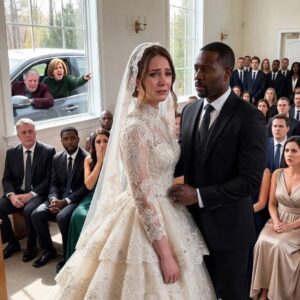
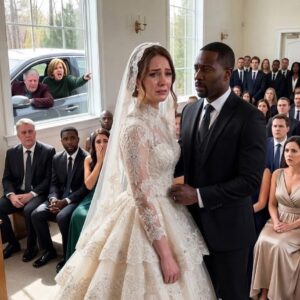
If you look carefully through the window, you can see my parents’ car beside the curb.
For years, my mother taught me that being abandoned by family was the worst thing that could happen.
She was wrong.
The worst thing would have been spending the rest of my life so afraid of an empty chair that I became willing to sit beside anyone, accept anything, and call it love.
On my wedding day, eighty-eight people stayed away because one person told them loyalty required it.
Eighty-eight others came because nobody required them to.
That was the difference I remembered.