PART 2
Because they had been raised to respect adults, even when the adult wasn’t being particularly respectful in return.
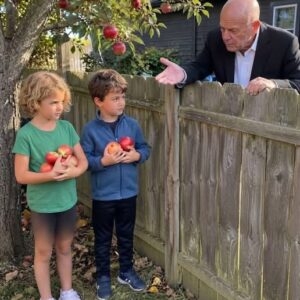
They gathered every apple.
Not just the ones already in the bucket
They went under the swing set.
Into the flower bed.
Along the fence.
Maya was only six.
She could carry about three apples at a time.
She made four trips.
Four.
Each time, she glanced toward me on the deck.
I finally called out,
“Dale.”
He ignored me.
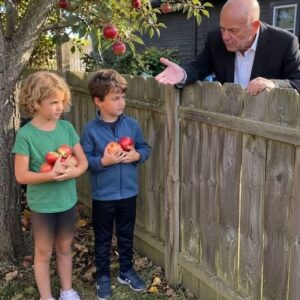
He simply stood by the fence accepting each load and putting the apples into a bag.
When the children finished, he tied the bag closed.
Then he looked directly at me.
“Nice,” he said. “Teaching them to steal early, are you?”
Maya immediately started crying.
Leo didn’t.
And somehow that hurt even more.
He stood there with dirty hands and red ears, staring at the ground.
I wanted to march straight to the fence.
I wanted to tell Dale exactly what I thought about nine years of cleaning up fruit from his tree only to have him humiliate two children who were trying to help.
Instead, I took two pictures.
One of Maya wiping her face.
One of Leo standing silently in the yard.
Then I sent them to Rob.
My message said:
“He stood at the fence and made them return every apple from our yard.”
Rob called less than a minute later.
“I’m coming home.”
“No.”
“He called our kids thieves.”
“I know.”
“Then I’m coming home.”
“Rob, if you walk over there furious, the entire street sees two adults screaming across a fence. Somehow we end up looking like part of the problem.”
There was a pause.
Then Rob said,
“I’ve got a better idea.”
“What?”
“I think I know how to teach him something without saying one rude word.”
I knew my husband well enough to recognize that tone.
“Rob…”
“Save the pictures. Email them to me. Then go be with the kids.”
So I did.
Inside, I made hot chocolate.
Maya was still upset.
Leo sat across from her at the kitchen table.
Finally, he said,
“Dale isn’t very nice.”
“No,” I said.
“Why did we have to give him the apples?”
I thought carefully.
“Because technically, they came from his tree.”
Leo frowned.
“But they were in our yard.”
“I know. And that’s where things get complicated. Sometimes someone can point to a rule and claim they’re right. But being technically right and being a good neighbor aren’t always the same thing.”
“What’s the difference?”
“Being a good neighbor means thinking about what is fair for everyone, not only what you can claim for yourself.”
Leo considered that.
“He wasn’t being a good neighbor.”
“No.”
“So what are we going to do?”
“We’re waiting for Dad.”
An hour later, Rob came home.
He wasn’t angry anymore.
Or at least he wasn’t showing it.
Instead, he walked into the kitchen carrying a shopping bag.
He pulled out gallon-size storage bags.
Canning jars.
And a huge bag of sugar.
Leo stared at it.
“What’s all that for?”
“Applesauce,” Rob said.
Then he added,
“Apple butter too. Maybe cider if we have enough.”
Leo looked confused.
“We don’t have apples anymore. We gave them to Dale.”
“We gave him the apples that had already fallen,” Rob explained.
He pointed toward the backyard.
“But that tree isn’t finished. I’ve watched it for nine years. The biggest drop happens over the next couple of weeks.”
Maya’s eyes widened.
“More apples are coming?”
“A lot more.”
“So what do we do?”
Rob smiled.
“We collect every apple that lands in our yard.”
“What about Dale?”
“He already taught us what kind of neighbor he wants to be.”
Rob leaned back.
“So we get to decide what kind of family we want to be.”
Over the next few days, the apples began falling heavily.
One morning, the grass beneath the branches was covered.
I grabbed the bucket.
But this time, picking them up didn’t feel frustrating.
It felt purposeful.
Every apple from our side went into the bucket.
Then into a large cooler.
When the kids came home from school, they joined me.
Leo carefully searched beneath the swing set and through the flower beds.
Maya carried apples toward the cooler.
Four trips.
Exactly like before.
On her second trip, she smiled.
“Four trips again.”
“Does that bother you?”
She thought about it.
“No. It’s more fun this time.”
Rob’s plan had three parts.
Part one was obvious.
We were going to use the apples.
All of them.
Applesauce.
Apple butter.
Dried apple slices.
Maybe cider.
Then he showed me part two.
He opened his laptop to the website of a local food bank.
He had already registered us for a community donation program.
“We’re giving everything away,” he said.
“All of it?”
“All of it.”
I stared at him.
“That is going to be a huge amount of work.”
“I know.”
“And you think this is worth it?”
“Yes.”
Then he showed me part three.
A draft letter.
Addressed to Dale.
We spent the next two weekends turning apples into food.
There is nothing glamorous about processing that many apples.
Peeling.
Coring.
Cooking.
Sterilizing jars.
Checking seals.
Watching temperatures.
Cleaning the kitchen again and again.
The entire house smelled like autumn.
The kids helped wherever they safely could.
Maya peeled.
Slowly.
Very slowly.
But she was determined.
Leo handled the repetitive jobs with the serious focus he brought to anything that had clear instructions.
Rob cooked.
I handled the canning.
By the end of the second weekend, our table was covered.
Seventy-eight jars of applesauce.
Twenty-two jars of apple butter.
Several pounds of dried apple slices.
And three gallons of cider.
Maya stared at everything.
“All of that came from the apples in our yard?”
“Yes,” Rob said.
“And we’re giving it away?”
“Yes.”
“To people who need food?”
“Exactly.”
She looked at the jars for a long moment.
Then she said,
“Dale didn’t want us to have the apples.”
“No,” Rob said.
“But now lots of people get them.”
“Yes.”
She smiled.
“That’s better.”
“I think so too.”
The following Sunday, we loaded everything into the car and drove to the food bank.
A coordinator named Helen met us at the loading area.
She opened one of the boxes.
“Did you make all this yourselves?”
“We did,” Rob said.
She noticed the labels.
Maya had made them from construction paper, each one decorated with little hand-drawn apples.
Helen smiled.
“Did you make these?”
Maya stood a little straighter.
“Yes.”
“They’re beautiful.”
“I peeled apples too.”
Helen became very serious.
“That is real work.”
Maya nodded solemnly.
“It is.”
Then Helen asked where all the apples had come from.
Maya glanced at us.
Rob nodded.
“Our neighbor’s tree,” she explained. “The branches hang over our yard, so the apples fall into our grass.”
“And your family turned them into all this?”
“Dad cooked most of it,” Maya said immediately. “But I helped peel.”
Credit accuracy mattered greatly to her.
That night, we finished the letter.
Rob had rewritten it several times because he didn’t want it to sound angry.
He wanted it to sound clear.
We told Dale exactly what had happened.
That the children had collected apples from our yard and tried to return them.
That he had made them gather every last one.
That Maya had needed four trips.
And that afterward, he had called them thieves.
We told him Maya cried.
We told him Leo didn’t.
Then we explained what happened afterward.
More apples fell.
We collected them.
Processed them.
And donated everything to the local food bank.
Seventy-eight jars of applesauce.
Twenty-two jars of apple butter.
Dried apples.
Cider.
And labels made by the same children he had called thieves.
Then we wrote the sentence Rob cared most about:
“Our children are not thieves. They are children who saw something that needed cleaning and tried to help.”
We didn’t threaten him.
We didn’t insult him.
We didn’t tell other neighbors.
We didn’t post anything online.
We simply told him what his actions had caused.
And what we had chosen to do with them.
Rob put the letter in Dale’s mailbox on Monday morning.
Then we waited.
Three days later, someone knocked on our door.
It was Dale.
He was holding a reusable grocery bag.
Inside were apples.
His apples.
Not windfalls from our lawn.
Good apples from his side of the tree.
He looked uncomfortable.
“The kids still like apples?”
I stared at the bag.
“They do.”
He handed it to me.
I took it.
He didn’t apologize.
Not directly.
He didn’t mention calling them thieves.
He didn’t mention Maya crying.
But he was standing at my front door.
Holding apples.
“I heard you donated everything,” he said.
“We did.”
He looked toward the backyard.
“That tree produces too much. I haven’t been able to use all of it for years.”
There was something in the way he said it.
Something quieter.
“I used to have help with it,” he added. “I don’t anymore.”
I didn’t ask what happened.
Instead, I said,
“If you want, we can keep collecting the apples that fall on our side. We’ll process what we can and donate it.”
He stared at me.
“You’d still do that?”
“If you’re okay with it.”
For several seconds, he said nothing.
Then he nodded.
“Yeah. All right.”
After he left, I called Rob.
“He brought apples.”
There was a pause.
“Okay.”
“He didn’t apologize.”
“No. I didn’t think he would.”
“Is that enough?”
Rob thought about it.
“It’s something.”
Then he added,
“And something is more than what we had before.”
That was when I realized the most important part of Rob’s plan wasn’t really teaching Dale a lesson.
It was teaching our children.
Maya and Leo had watched everything.
They saw what happened at the fence.
They saw Maya cry.
They saw us get angry.
But they also watched us decide not to answer cruelty with more cruelty.
They watched us spend two weekends working.
They helped transform something unpleasant into food.
They watched us deliver it to people who needed it.
They saw Rob write a calm letter instead of starting a shouting match.
One night, Leo asked him,
“Why did you tell Dale everything we did?”
Rob answered,
“Because sometimes when someone treats you badly, the strongest response is showing them very clearly what kind of person you choose to be.”
“The letter showed him?”
“The letter told him. What we did showed him.”
Leo thought about that.
“He called us thieves.”
“Yes.”
“But we gave everything away.”
“Yes.”
“So we did the opposite of stealing.”
Rob smiled.
“Exactly.”
Winter came.
Dale didn’t suddenly become a cheerful old man.
He didn’t start coming over for coffee.
He didn’t become affectionate.
But something changed.
He acknowledged us differently.
There was less hostility in him.