PART 3
The first recipient was a twenty-year-old single mother named Jasmine who worked nights at a grocery store.
At the ceremony, she stood beside me trembling.
“My family says law school is unrealistic.”
I smiled.
“Mine did too.”
She stared at me.
“You?”
“Especially me.”
She laughed nervously.
I handed her the certificate.
Then I gave her the words I had needed at nineteen.
“You don’t have to prove you’re exceptional before you’re allowed to try.”
Her expression changed.
I knew that look.
A door opening inside someone.
Brenda attended the ceremony.
She sat quietly in the back.
My parents did not.
Not because they weren’t welcome to ask.
Because I hadn’t invited them.
Some boundaries remained.
Brenda and I eventually built something that wasn’t the sisterhood of childhood but wasn’t inherited hostility either.
It was smaller.
Intentional.
Coffee.
Birthday messages.
Occasional dinners.
Honesty.
Years later, she asked if I had forgiven her.
We were walking beside the Charles River as autumn leaves moved along the path.
I thought for a while.
“I don’t know.”
She nodded.
“Fair.”
“But I don’t wake up angry anymore.”
Her eyes filled.
“That might be more than I deserve.”
“Don’t do that.”
“What?”
“Turn guilt into another way of making yourself the center.”
She laughed.
“Ouch.”
“Lawyer.”
“I remember.”
We kept walking.
My parents changed as well.
Slowly.
Imperfectly.
My mother learned to ask about my work without comparing me to Brenda.
My father attended one of my arguments and sat silently in the back.
Afterward, he waited outside the courtroom.
“You were good.”
I looked at him.
He corrected himself.
“You were extraordinary.”
I smiled faintly.
“I’m allowed to be average sometimes too.”
His face tightened.
He understood.
“Yes.”
That answer mattered more than the compliment.
Judge Morland retired five years after the disciplinary hearing.
Her retirement reception filled the courthouse.
Prosecutors.
Defense lawyers.
Clerks.
Judges.
Former defendants.
People whose lives had crossed her courtroom.
When I approached, she smiled.
“Fitzgerald.”
I laughed.
“I’m never escaping that case, am I?”
“No.”
She took my hand.
“Although I remember another hearing rather well.”
My smile faded.
“So do I.”
She studied me.
“How is your family?”
“Complicated.”
“Most evidence is.”
I laughed.
Then she grew serious.
“You know, Claire, I regretted praising you that day.”
I blinked.
“What?”
“For about five minutes.”
“Why?”
“Because I worried they’d hear my praise and suddenly decide you had value.”
The room seemed to quiet.
She squeezed my hand.
“And I didn’t want you confusing their recognition with proof.”
My throat tightened.
“I did that for years.”
“I know.”
“How?”
She smiled.
“Thirty years on the bench.”
I looked away, blinking hard.
Then she said, “Your grandmother would have been proud.”
I stared at her.
“How do you know about my grandmother?”
Judge Morland lifted her eyebrows.
“You never figured it out?”
My heart quickened.
“Figured what out?”
She looked almost amused.
“Who recommended your Lakewood adviser for that position?”
I stopped breathing.
“My grandmother knew her?”
“Not exactly.”
Judge Morland reached into her handbag and removed an old envelope.
Inside was a photocopied letter.
My grandmother had written it years before her death.
To Judge Morland.
They had volunteered together on a local legal-aid board.
My grandmother wrote about a granddaughter who argued constantly, spotted every contradiction, and whose family kept urging her to choose something “realistic.”
At the bottom, she had written:
If Claire ever finds her way toward law, please make sure somebody takes her seriously before she learns not to take herself seriously.
My hands began trembling.
Judge Morland continued.
“I knew your adviser’s former supervisor. When Lakewood hired her, I mentioned that there was a student coming through who might need someone stubborn enough to recognize her.”
I stared at the letter.
“The adviser knew?”
“Not your whole story.”
Judge Morland smiled.
“She just knew to watch for you.”
My eyes filled.
All those years, I had believed I built everything alone.
I hadn’t.
Not completely.
Someone had been leaving small lights ahead of me before I even knew where the road led.
My grandmother.
My adviser.
Professors.
Mentors.
Judges.
People who saw something in me without requiring me to become extraordinary first.
I pressed the letter against my chest.
“Why didn’t anyone tell me?”
Judge Morland’s expression softened.
“Because sometimes support works best when it doesn’t become another debt.”
That sentence stayed with me.
Years later, when I became a partner at Mercer, Vale & Bishop, my name appeared on the glass doors.
Claire Hamilton.
On the first morning, I stood outside staring at it.
Not because I needed my family to see it.
Not anymore.
A young associate hurried up behind me carrying three case files, looking terrified.
“Ms. Hamilton?”
I turned.
“Claire.”
She blinked.
“Sorry?”
“Call me Claire unless we’re in court.”
She smiled nervously.
“Okay.”
Then she glanced at my name on the door.
“Does that ever stop feeling strange?”
I thought about sixteen-year-old me.
Community college.
Suffolk.
The hearing.
My grandmother’s letter.
Judge Morland.
Brenda.
My mother admitting that pride had mattered more than truth.
“No,” I said.
“Good strange?”
I opened the door.
“Earned strange.”
She laughed.
We went inside.
Only three things hung on my office wall.
My law license.
My grandmother’s note.
And the first scholarship recipient’s thank-you card.
Not Fitzgerald.
Not my awards.
Not the magazine profiles that came later.
Those weren’t what reminded me who I was.
One rainy evening, long after everyone else had gone home, I sat alone preparing for trial.
Boston glowed beyond the windows.
My phone buzzed.
A message from Brenda.
Mom found another box. Apparently she saved your high school debate certificate too. She is becoming an archivist in her old age.
I laughed.
Then another message came.
Also, for the record, I remember that dinner when you were sixteen.
My fingers stopped.
Then a third.
Mrs. Crawford asked what you wanted to do. Mom answered community college. You looked at me afterward like you wanted to disappear.
I stared at the screen.
Another appeared.
I laughed. I have thought about that laugh a thousand times. I’m sorry.
I typed back.
I remember.
The dots appeared.
Disappeared.
Appeared again.
Finally:
I know.
I looked across the rainy city.
For years, I imagined healing would mean forgetting that laugh.
Now I understood healing meant remembering it without hearing my worth inside it.
I typed one final sentence.
Good night, Brenda.
Her reply came immediately.
Good night, Claire.
I set the phone down.
The office settled into silence.
Rain traced silver lines down the windows.
On my desk lay a case file for a client everyone had already decided was guilty.
I opened it.
Page one.
Facts.
Evidence.
Contradictions.
The work.
The same work that had saved me from living inside other people’s assumptions.
I smiled.
Then the young associate called from the hallway through my half-open door.
“Claire?”
“I thought you went home.”
“So did I.”
She appeared holding a folder.
“I think I found something in the deposition transcript.”
I pointed toward the chair.
“Show me.”
She sat.
Nervous.
Excited.
Her finger landed on a single line.
I read it.
Then read it again.
She was right.
It was small.
But cases can turn on small things.
So can lives.
A sentence.
A teacher.
A scholarship.
A forgotten letter.
One person taking you seriously before you learn how to take yourself seriously.
I looked at her.
“Good catch.”
Her face brightened.
“Really?”
“Really.”
I watched confidence arrive.
Quietly.
Almost invisibly.
And suddenly I understood what my grandmother had done.
She hadn’t built the road for me.
She had simply made sure one light was on when I reached it.
That was different.
And better.
I pushed the file back toward the associate.
“Follow it.”
She nodded and hurried away.
I stayed by the window.
Below me, people moved beneath umbrellas along wet Boston streets.
Thousands of lives.
Thousands of stories.
People underestimated.
People praised too soon.
People carrying their families inside their heads long after leaving home.
I touched my grandmother’s note.
For law school, when she finally admits that’s where she’s going.
I smiled.
She had known before I did.
Maybe that was the final truth.
I spent half my life believing my family had failed to see me and the other half proving I could succeed without being seen.
But I had been seen.
Not by everyone.
Not by the people whose approval I once wanted most.
But by enough people.
A grandmother.
An adviser.
A judge.
A colleague.
Eventually, a sister trying imperfectly to become better.
And finally, myself.
I turned off the desk lamp.
The office went dark except for the city beyond the glass.
My name remained faintly visible on the door.
Hamilton.
The same name my parents gave me.
For years, I had considered changing it.
Eventually, I realized I didn’t have to surrender it.
A name could carry the people who underestimated you without belonging to their version of who you were.
I picked up my coat.
Before leaving, I glanced once at my license.
The document my sister had sworn could not exist.
It hung quietly on the wall.
No spotlight.
No applause.
No disciplinary committee.
Just paper behind glass.
Technically, proof.
But I didn’t need proof anymore.
I closed the office door.
Downstairs, the lobby guard waved.
“Night, Ms. Hamilton.”
“Good night.”
Outside, the rain had softened.
I opened my umbrella.
My phone buzzed once more.
A photograph from Brenda.
My mother stood beside the old dining-room table holding my high-school debate certificate.
On the back, in my mother’s handwriting, were four words I had never seen.
Claire was excellent tonight.
I stopped beneath the awning.
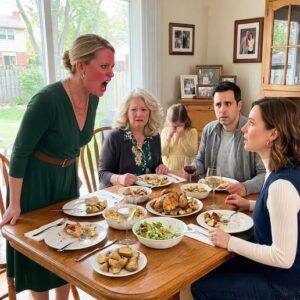
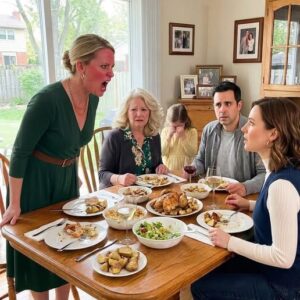
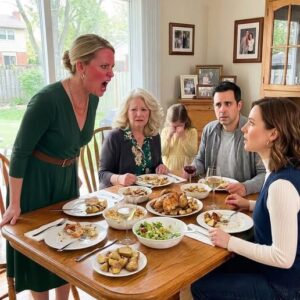
For one moment, sixteen-year-old me stood beside me again.
Black dress.
Tray of appetizers.
Trying not to react when her sister laughed.
I wanted to tell her everything.
That community college would not be a consolation prize.
That ramen would taste awful.
That law school would nearly break her.
That her family would miss her graduation.
That she would pass the bar anyway.
That one day, a judge would remember her.
That someday the family who doubted her would accuse her of inventing the very life she had built because accepting the truth would be harder.
That she would survive that too.
But more than anything, I wanted to tell her she did not need to construct an undeniable life.
She was allowed an ordinary one.
A difficult one.
A brilliant one.
A messy one.
Whatever life she chose.
Worth had never been the reward waiting at the finish line.
She had carried it into that dining room before anyone spoke.
I looked at the photograph again.
Then typed to Brenda.
Keep it for me.
She replied:
I will.
I put my phone in my pocket and stepped into the rain.
Cars crawled through the intersection.
A bus sighed beside the curb.
Someone laughed beneath an umbrella.
The city smelled of wet pavement and coffee.
Nothing dramatic happened.
No judge announced my name.
No family member apologized.
No room went silent.
I simply walked home.
And for the first time, I understood why that felt like the greatest victory of all.
I no longer needed anyone to study my life and admit they had been wrong.
I only needed to keep living it.
So I did.