PART 2
Inside were old real-estate listings clipped from newspapers.
Small cottages in Seaside.
Manzanita.
Cannon Beach.
Some dated back to the 1990s.
On one faded clipping showing a little gray house near the ocean, Mom had circled the porch and written:
**Sam, look at that view.**
That was when I understood.
My parents had once planned to retire near the coast.
And they had spent their someday on us.
I quietly put the folder back.
I never told them I had seen it.
But I never forgot.
Years passed.
I’m forty-four now.
When I was twenty-nine, I started a logistics company with a used box truck and a bank loan.
Today we move freight throughout the West Coast.
More than three hundred employees.
Warehouses in Portland, Sacramento, and Tacoma.
I’m not television-billionaire rich.
But I’ve done well.
Very well.
For years, I tried to give my parents money.
They refused.
“Everything we need is already here,” Dad would say.
I offered him a new truck.
“The old one still runs.”
I offered to pay off their mortgage.
“Almost finished anyway.”
I offered Hawaii.
Dad claimed he hated flying.
He had never actually been on an airplane.
Mom eventually told me,
“Lucas, we didn’t raise you so you could repay us. We raised you so you could have a good life. Go live it.”
Then, two years ago, Dad was diagnosed with Parkinson’s disease.
It began with a tremor in his right hand.
Small at first.
A coffee cup.
A page turning.
He tried hiding it.
Mom noticed.
Then I noticed during Thanksgiving when he struggled to carve the turkey.
The neurologist told us it was still early.
Medication could help.
Dad could have many good years.
But eventually his balance, walking, and possibly his speech would become more difficult.
Dad accepted the diagnosis the same way he accepted everything.
Quietly.
In the hospital parking lot, he said,
“Well, I guess being a brain surgeon is off the table.”
Mom laughed.
Then cried during the drive home.
Dad held her hand with his trembling right hand.
That was the moment I decided.
They had given up their someday for me.
I was going to give it back while Dad could still walk on the beach.
It took four months.
I toured forty-one properties along the Oregon coast.
Then my realtor showed me a house in Cannon Beach.
Cream-colored exterior.
White trim.
Gray roof.
Two stories, but importantly, the main bedroom and bathroom were downstairs.
Dad wouldn’t need stairs later.
A wraparound porch ran along three sides.
Beyond it were dunes.
Sea grass.
Sand.
And the Pacific Ocean.
From the porch you could see Haystack Rock.
I stood there in the cold March wind and remembered Mom’s handwriting on that yellow newspaper clipping.
**Sam, look at that view.**
The house cost $425,000.
I paid cash.
But I made one important decision.
I kept the legal title in my name.
My attorney, Naomi Reyes, recommended it.
She had handled my company’s legal matters for twelve years and had never given me bad advice.
“Your father has a progressive neurological disease,” she said. “Your mother is getting older. They’re kind people, Lucas. Trusting people. That can make them vulnerable.”
“A scammer. A contractor. Even a relative could pressure them.”
I told her my family wasn’t like that.
She gave me a look.
“Every family says that. Until something happens.”
So we created an arrangement.
I remained the legal owner.
My parents received a written lifetime right to live there.
No rent.
No conditions.
Nobody could sell the property.
Mortgage it.
Transfer it.
Or remove them.
Not even me.
The house would always be available to them.
I handled taxes and insurance.
Their only responsibility was to live there.
I placed the original deed and agreement inside a sealed folder bearing the county recording stamp.
Then I locked it inside the bottom drawer of a small antique writing desk by the front windows.
I kept the key.
I remember thinking:
**We’ll never need this.**
I was wrong.
My parents’ fiftieth wedding anniversary fell on June 14.
Fiona wanted a large celebration.
Hall.
DJ.
Two hundred guests.
“Our parents would hate that,” I told her.
She wanted to know what my better idea was.
I didn’t tell her.
Maybe I should have.
On the morning of their anniversary, I picked Mom and Dad up from the blue house on Alder Street.
I told them we were taking a drive.
“To the ocean?”
Dad raised an eyebrow.
“On a Thursday?”
“It’s your anniversary. The ocean works on Thursdays.”
The drive took almost two hours.
The sky was gray.
Typical Oregon coast.
When I pulled into the driveway, Dad looked toward the house.
“Who lives here?”
I didn’t answer.
I got out.
Opened Mom’s door.
Then pulled a silver key ring from my pocket.
Two keys.
A little brass seashell charm.
I placed them in Mom’s palm.
“Happy anniversary, Mom.”
Then I looked toward Dad.
“Happy anniversary. Welcome home.”
Mom stared at the keys.
Then at the house.
Then at me.
“Lucas… what did you do?”
“I bought you your someday.”
For several seconds, she didn’t understand.
Then suddenly she did.
Her hand covered her mouth.
“The folder.”
I smiled.
“You found the folder.”
“Twenty-two years ago.”
She began crying.
No cameras.
No speeches.
No giant party.
That wasn’t who my parents were.
Dad slowly climbed out of the car using his cane.
He walked toward the porch.
One step at a time.
Then around to the side facing the ocean.
He placed both weathered hands on the white railing.
His right hand trembled.
He tightened his grip.
And stared across the dunes toward Haystack Rock.
Mom walked up behind him.
She rested one hand on his back.
“Sam.”
He turned slightly.
“Look at that view.”
That was the third time I saw my father cry.
For the next three weeks, my parents sounded happier than they had in years.
Mom called every evening.
She told me about tide pools.
Puffins.
A bakery selling marionberry scones.
A seal sleeping on the beach.
“Your father walks every morning,” she told me.
“Down to the water and back.”
“The doctor says walking is good for him.”
I asked whether Dad was careful.
“We hold hands.”
She laughed.
“Fifty years together and we’re walking on the beach holding hands like teenagers.”
Once, Dad took the phone.
He hated phones.
He said exactly three sentences.
“The porch is good.”
“I watch the sunset every night.”
“Thank you, son.”
Those words mattered more to me than anything my company had ever earned.
Then Fiona arrived.
My sister is three years older.
We were close as children.
She taught me to ride a bicycle.
Defended me at school.
But somewhere during adulthood, something changed.
Fiona became a dental hygienist.
She worked hard.
Made decent money.
Then she married Gregory Halvorsen.
Gregory sold real estate.
Or tried to.
He was always talking about his next big transaction.
His next investment.
His next opportunity.
He drove an enormous black pickup and wore expensive sunglasses.
At family gatherings, he called me “the trucker.”
Even though I hadn’t personally driven a truck for years.
“How’s the trucking business, trucker?”
My parents never said they disliked him.
But I could tell.
Fiona and Gregory had two sons.
Owen, sixteen.
Quiet and serious.
Caleb, fourteen.
Funny and energetic.
Over the years, Fiona called less often.
And when she did call, she usually needed help.
Roof repairs.
Braces.
Gregory’s truck payment.
I helped.
She was my sister.
When she discovered I had purchased the beach house, she called immediately.
“A beach house?”
“You bought Mom and Dad a house in Cannon Beach?”
“For their anniversary.”
“How much?”
“Why does that matter?”
Her voice tightened.
“You didn’t include me.”
I tried explaining.
She interrupted.
“You didn’t even think about me.”
Then hung up.
Two weeks later, Mom called.
“Your sister is visiting.”
Fiona, Gregory, and the boys were coming for a few days.
Mom sounded delighted.
I thought nothing of it.
Why would I?
My sister was visiting our parents.
Then a few days became a week.
A week became two.
Mom’s evening calls became shorter.
She sounded tired.
“When are they leaving?” I asked.
“Soon.”
Apparently Gregory was experiencing a “slow period” in real estate.
Near the end of the second week, Dad got on the phone.
“Gregory’s asking questions about the house.”
“What questions?”
“Value.”
“Taxes.”
“Whether it’s paid off.”
I told him Gregory could call me.
He never did.
Then Mom stopped calling.
Three days.
Four.
Five.
I called her.
Voicemail.
I called the house.
No answer.
Then I called Fiona.
“Mom’s fine.”
Too quick.
“She’s busy.”
“Why isn’t she answering?”
“Maybe she lost her phone. She’s seventy-three, Lucas.”
“My mother has never lost her phone.”
Fiona became defensive.
“People get old. Dad is sick. Mom’s getting forgetful. Maybe you’d know if you were ever actually around.”
Then she hung up.
I was sitting in my Portland office when an unfamiliar number texted me.
**Uncle Lucas, this is Owen. Please don’t tell Dad I texted you. Something is wrong. Dad keeps yelling at Grandpa. Grandma is scared. I don’t know what to do.**
Everything inside me went cold.
Before I could answer, Mom called.
“Mom?”
For several seconds, all I heard was breathing.
Then her voice came through barely above a whisper.
“Lucas…”
“Sweetheart…”
“Maybe you should come.”
I heard a man shouting somewhere behind her.
Then the call disconnected.
I canceled my meeting.
Grabbed my keys.
Started driving toward Cannon Beach.
On the highway, I texted Owen.
**I’m coming. Stay near Grandma and Grandpa. You did the right thing.**
He responded immediately.
**Hurry.**
Then I called Naomi.
The moment I explained what was happening, her tone changed.
“Where’s the deed?”
“In the house.”
“Locked in the writing desk.”
“I have the key.”
“Good.”
Then she warned me.
“If anyone has tried getting your parents to sign something, don’t let anyone destroy or remove it.”
I asked why anyone would do that when my parents didn’t own the house.
Her answer stayed with me.
“People who don’t know who owns the house often assume it belongs to whoever looks weakest.”
By coincidence, Naomi was working in Astoria.
She could reach Cannon Beach quickly.
“Call me when you arrive.”
I reached the house at 3:40.
Gregory’s giant pickup was parked sideways across the garage doors.
Wet towels covered the porch railing.
Coolers.
Beach chairs.
A boogie board crushed Mom’s flowers.
One front window was cracked.
Loud music shook the walls.
Then I heard Gregory shouting.
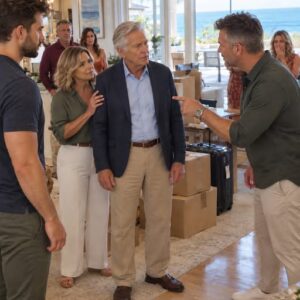
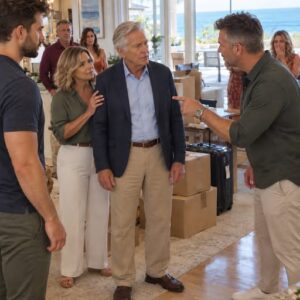
I opened the front door.
Mom stood near the staircase with a kitchen towel pressed against her mouth.
Her eyes were red.
Dad stood by the entry table.
His cane was lying on the floor several feet away.
His whole body was shaking.
Not just the Parkinson’s tremor in his hand.
Everything.
At his feet was a cardboard banana box.
Inside were his clothes.
His medication organizer.
His reading-glasses case.
And the framed photograph from the night we celebrated their anniversary.
The glass had cracked.
Gregory stood inches from my father.
“This is my house now, old man.”
“You and Irene need to pack your things and leave.”
Fiona stood nearby holding one of Mom’s wedding crystal glasses filled with white wine.
And then my sister laughed.
“Dad, stop being dramatic.”
“You and Mom don’t need this much space.”
“Gregory and I have children.”
“Lucas won’t care.”
Gregory kicked the box.
It slid into Dad’s shoes.
The photo fell.
My father looked down at it.
He didn’t argue.
That hurt more than anything.
This was the man who worked forty-three years.
Who drove a rusted truck so his children could attend college.
Who skipped vacations for twenty years.
Who built me an attic bedroom with his own hands.
And he stood inside the house I had bought for him looking like someone caught trespassing.
I shut the front door.
Then walked into the kitchen and turned off the speaker.
The music stopped.
Fiona’s smile vanished.
Gregory turned around.
“Lucas,” Fiona said quickly. “Good. We were going to call you.”
“Were you?”
“We need to discuss arrangements.”
Gregory crossed his arms.
“Hey, trucker. This is family business.”
I looked down at Dad’s box.
“It certainly is.”
I picked up Dad’s cane.
Placed it in his hand.
Then adjusted his glasses.
“You okay, Dad?”
He nodded.
Barely.
Then I turned around.
“Someone want to explain?”
Fiona began describing how Mom and Dad supposedly couldn’t manage such a large property anymore.
Dad’s Parkinson’s.
Mom’s age.
Maintenance.
Gutters.
Deck staining.
All the practical reasons.
Then she revealed their solution.
A senior living facility in Bend.
“Pine Ridge.”
“It’s very nice.”
I asked what it cost.
Fiona hesitated.
“Their savings should cover it for a while.”
Their savings.
Roughly $380,000.
Nearly everything my parents had accumulated after putting my sister and me through school.
“And you would live here?”
“We would take care of the house,” Gregory said.
“For the family.”
Then he made the mistake that changed everything.
He picked up a manila folder.
“We already have the paperwork.”
He waved it at me.
“Samuel just needs to sign.”
My mother shook her head slightly.
No.
Dad looked at me.
And suddenly I understood.
Gregory and Fiona hadn’t merely overstayed.
They had been trying to pressure my parents into signing documents.
Possibly for days.
That explained Mom’s missing phone.
The silence.
The fear.
The box.
I extended my hand.
“Give me the folder.”
Gregory pulled it toward his chest.
“You don’t need to see it.”
“I think I do.”
“This is between us and your parents.”
“They’re adults.”
“They can sign whatever they want.”
“You’re not their guardian.”
That was when I smiled.
Nothing was funny.
Dad was shaking.
Mom was crying.
But Gregory still believed he was negotiating with the frightened son of two elderly homeowners.
He had no idea that I legally owned every inch of the house.
“Interesting.”
I looked at him.
“Tell me again whose house this is.”
Gregory’s jaw tightened.
“Ours.”
“Now.”
I took out my phone.
Made one short call.
“Come inside.”
Then I walked to the antique writing desk.
Unlocked the bottom drawer.
Removed the sealed property folder.
I broke the seal.
Pulled out the deed.
Placed it on the table beside Dad’s box.
Fiona leaned over.
Her eyes moved down the page.
Property description.
Parcel number.
Recording date.
Then owner:
**Lucas Samuel Sinclair.**
Her face turned white.
Gregory went silent.
“That’s impossible.”
“Irene said it was a gift.”
“It was.”
I pointed toward my parents.
“I gave them the right to live here for the rest of their lives.”
“No rent.”
“No conditions.”
“No one can remove them.”
Then I tapped the deed.
“But I kept ownership.”
“For exactly this reason.”
Gregory slowly looked down at the documents he had brought.
Whatever scheme he believed he had constructed was collapsing.
Then the front door opened.
Naomi Reyes walked inside carrying a leather briefcase.
She looked once around the room.
Dad.
Mom.
The box.
The broken picture.
The wineglass.
Then she noticed the folder in Gregory’s hands.
“Nobody touch that folder.”
Gregory went pale.
Naomi identified herself as my attorney.
Then advised him to place the documents on the table.
He eventually did.
She examined the first paper.
A quitclaim deed.
It attempted to transfer my parents’ interest in the property to Fiona and Gregory for ten dollars.
Signature spaces remained blank.
“This document accomplishes nothing,” Naomi said.
“They don’t own the property.”
“But it tells me what you believed you were doing.”
The second document was much worse.
A durable power of attorney.
It gave Fiona control over Mom and Dad’s finances.
Investments.
Medical decisions.
Living arrangements.
Naomi became very serious.
Then came the third document.
An application to Pine Ridge Senior Living.
Already completed.
Under reason for placement:
**Progressive cognitive and physical decline. Family unable to provide care.**
Under payment:
**Resident savings — approximately $380,000. Managed by Power of Attorney.**
Attached was a handwritten note:
**Mobile notary booked — Friday 10 a.m. Get Sam to sign tonight. Irene will follow.**
Naomi looked at Fiona.
“Does your father have cognitive impairment?”
Fiona said nothing.
“I’ve spoken with Samuel recently,” Naomi continued.
“He has Parkinson’s disease.”
“His body is affected.”
“His mind is not.”
Then she asked my parents directly whether anyone had pressured them.
Mom began crying.
Dad placed his trembling hand on her arm.
“Tell her, Reenie.”
Mom finally spoke.
Gregory had taken her phone five days earlier.
He told her she was calling me too often.
He warned that if they refused to sign, he would tell doctors Dad was incapable of caring for himself.
He threatened that Dad could be placed somewhere Mom couldn’t visit.
But if they signed?
“At least you can go together.”
I took one step toward Gregory.
Naomi immediately placed her hand against my chest.
“Lucas.”
“Don’t.”
I stopped.
Mom then explained how she managed to call me.
Owen had taken her phone from Gregory’s truck while he was showering.
“Call Uncle Lucas, Grandma.”
Owen had also texted me himself.
Gregory turned toward his sixteen-year-old son.
“You went through my truck?”
Owen stood.
His hands shook.
“Yeah.”
“And I texted Uncle Lucas.”
“You were yelling at Grandpa.”
“He’s sick, Dad.”
Then he looked at Fiona.
“And Mom just stood there.”
Gregory ordered him to sit down.
Owen didn’t.
“No.”
Twelve minutes later, a sheriff’s vehicle arrived.
Deputy Hanna Lindqvist listened to Naomi.
Inspected the deed.
The documents.
The box.
Then looked directly at Gregory.
“The property owner has asked you to leave.”
Gregory protested.
“This is my wife’s parents’ house.”
“No, sir.”
“You were guests.”
“The residents and owner have revoked that permission.”
“At this point, remaining here would be trespassing.”
Then she addressed the attempted coercion involving elderly adults.
She told Gregory a report would be filed with Adult Protective Services.
Gregory finally turned toward Fiona.
“Get the boys.”
She didn’t move.
“Fiona. Now.”
She looked at Owen.
Caleb.
Our father.
Then at Gregory.
“No.”
He blinked.
“What?”
“I’m not going with you.”
Not that night.
Maybe not ever.
Gregory eventually walked out alone.
Afterward, the deputy took my parents’ statements.
Slowly.
Gently.
Before leaving, she crouched beside Dad.
Her own father had lived with Parkinson’s disease.
“You did well today, Mr. Sinclair.”
“You didn’t sign.”
Dad looked down.
“I almost did.”
“I had the pen in my hand.”
“But you didn’t.”
“No.”
“I didn’t.”
That evening, Naomi took the documents with her.
Before leaving she told me,
“You were right to keep the title.”
I admitted that sometimes I had felt guilty.
As though protecting the property that way meant I didn’t trust my own family.
“Don’t feel guilty.”
“Sometimes loving people means making it impossible for someone else to take advantage of them.”
“That isn’t coldness.”
“It’s a lock on a door.”
Fiona stayed behind.
I found her sitting on the porch overlooking the ocean.
Eventually, she told me the truth.