The following is a clinical case of a dermatological disease with systemic repercussions that should be taken into account in the Primary Care consultation.
This is a 55-year-old woman with a medical history of high blood pressure and COPD. She had no allergies, smoked 10 cigarettes a day, and had been on regular treatment with enalapril for the past 6 years and inhaled formoterol for the past 2 years. Due to a worsening of her lung disease, the pulmonologist decided to reinforce her inhalation treatment by discontinuing formoterol and prescribing a combination of indacaterol and glycopyrronium inhaled capsules.
She attended the Primary Care clinic because, on the second day of the new inhaler treatment, she developed painful, erythematous patches on her cheeks and neck, accompanied by a low-grade fever (Fig. 1). The patient denied using any new cosmetics, had not made any changes to her usual diet, and did report sun exposure, albeit with adequate protection. She had not experienced any catarrhal symptoms in the previous days.
An urgent referral to Dermatology was decided for evaluation of the lesions. After being seen by the Dermatology Department, the patient was advised to discontinue the new medication, and a biopsy and blood tests were performed, including a complete blood count, antibodies, lupus anticoagulant, and serology tests. Oral corticosteroids were prescribed.
After 24-48 hours, the lesions diminish in intensity and the pain subsides. Blood tests reveal the presence of leukocytosis with neutrophilia, antibodies, lupus anticoagulant, and negative serology results.
Twenty days later, the results of the skin biopsy arrived and were positive for Sweet syndrome.
Sweet syndrome (also known as acute febrile neutrophilic dermatosis) is a dermatological disease classified within neutrophilic dermatoses, since histopathologically it is characterized by the presence of neutrophil infiltrates 1 .
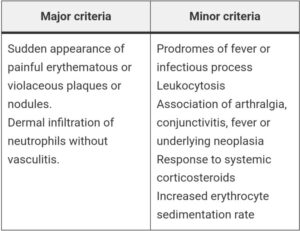
Clinically, it is characterized by the appearance of lesions in the form of erythematous papules or plaques distributed bilaterally, usually asymmetrical, with a sudden onset and pain. The most common locations are the face, neck, upper trunk, and hands. It is also characterized by the presence of systemic symptoms (fever, leukocytosis with neutrophilia, etc.) 2 (Table 1) 1,3 .Table 1.
Diagnostic criteria for Sweet syndrome
The etiology of Sweet syndrome is not known with certainty. According to some studies, the pathogenesis is mediated by cytokines involved in the chemotaxis and activation of neutrophils and histiocytes 4,5 . A hypersensitivity reaction is presumably triggered by a previous process, such as an upper respiratory tract infection or paraneoplastic processes, and also by the intake of medications 2,6,7 . Diagnosis is important, since it requires ruling out systemic disease, such as atypical forms of Sweet syndrome on the back of the hands, which may be the main sign of occult neoplastic diseases 8 .
In cases secondary to drugs or idiopathic, it is more frequent in the female sex 2 .
The drugs most frequently shown to be correlated with Sweet syndrome are contraceptives, antiepileptics, antibiotics, antihypertensives, colony-stimulating factors, and vaccines 6 . However, these drugs are not the only ones that are exclusivity-related, which is why we have presented this clinical case.
The first-line treatment for Sweet’s syndrome is oral corticosteroids, which respond rapidly, so that general discomfort and pain subside within the first few hours and the lesions disappear in less than a week 2 .
In this case of sudden onset of erythematous papular lesions on the face and neck, a differential diagnosis must be made with urticaria, contact dermatitis, and toxicoderma due to the appearance of the lesions, and with cutaneous lupus due to the characteristics of the lesions. Once all of these were ruled out based on the history and the results of complementary tests, and thanks to the conclusive diagnosis of the biopsy, the patient was diagnosed with Sweet syndrome.
Sweet’s syndrome can be induced by a large number of drugs and should be considered as a diagnostic option, especially if the relationship between drug exposure and the appearance of the lesions is clear. To date, there are no reported cases of Sweet’s syndrome secondary to inhalant therapy, making this the first; hence the importance of considering other drugs, even though they have not been described in the literature.
Since it is a rare disease, it is not usually established as a differential diagnosis at first, but it should be taken into account, especially because it can also involve not only the skin but also internal organs, being a marker of infections, inflammatory bowel disease, autoimmune connective tissue diseases, and malignant neoplasms, especially those of hematological origin.
Therefore, it is essential that after diagnosing Sweet syndrome, the study be completed to rule out associated organic conditions, such as tumors, rheumatic diseases, or infections.
Primary care physicians should consider all diagnostic possibilities, even if the diagnosis cannot be defined in the office. A primary care physician’s knowledge of rare diseases leads to early and correct referrals, enabling timely diagnosis and treatment.
Ethical Responsibilities Protection of People and Animals
The authors declare that no experiments were performed on humans or animals for this research.
Data confidentiality
The authors declare that they have followed their workplace protocols regarding the publication of patient data.
Right to privacy and informed consent
The authors have obtained informed consent from the patients and/or subjects mentioned in the article. This document is in the possession of the corresponding author.